
Tag: Cervical Radiculopathy

How to Sleep With Whiplash: Best Positions & The “Towel Trick”

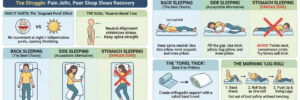
An educational infographic by CT Physical Therapy Care titled "Sleeping with a Whiplash Injury." The graphic illustrates the "Stagnant Pond" effect of inflammation at night and defines "Nose-to-Navel" alignment. It visually compares three sleeping positions: Back Sleeping (labeled "The Best Choice" with a cervical roll), Side Sleeping (labeled "Acceptable" with a pillow between knees), and Stomach Sleeping (marked with a red X as the "Danger Zone"). The bottom section illustrates the "Towel Trick" for creating DIY neck support, step-by-step diagrams for the "Log Roll" morning routine to avoid twisting, and a list of red flags like numbness and headaches.

“Is neck pain waking you up at 3:00 AM? Sleep is your body’s primary tool for healing whiplash, but poor positioning can turn it into a nightly battle. In this guide, we explain the ‘Nose-to-Navel’ rule for neutral alignment, reveal why stomach sleeping is dangerous for your recovery, and show you how to use the DIY ‘Towel Trick’ to get orthopedic support for free.”

Why Do My Hands Tingle After a Car Accident?

An infographic split into two panels. On the left, a transparent anatomical drawing of a human head and torso shows a glowing red pinched nerve in the neck (cervical spine) with a blue nerve pathway radiating down the arm to a hand. On the right, a cartoon illustration of a man with a pained expression holds his hand, which has numerous sewing pins and needles sticking out of it, surrounded by small electrical current lines. Large text at the top reads, "WHY DO MY HANDS TINGLE AFTER A CAR ACCIDENT? (It's Not Just Your Hand. It's Your Neck.)

You survived the crash and expected a stiff neck. But now, you’re feeling something stranger: “pins and needles” in your fingers. If you are dropping your keys or shaking out your hands, the problem likely isn’t in your hand at all—it’s in your neck. Learn why “Cervical Radiculopathy” is the most overlooked car accident injury and why New York’s 30-day insurance rule makes waiting dangerous.