
It is 3:00 AM. You are exhausted, but every time you drift off, a sharp pain in your neck jolts you awake.
If you recently suffered a car accident, you know this struggle well. Whiplash turns the simple act of sleeping into a nightly battle. You toss, you turn, and you punch your pillow trying to get comfortable—but nothing works.
At CT Physical Therapy Care in Woodside, we know that sleep is not just about comfort; it is your body’s primary healing tool.
If you sleep poorly, your inflammation stays elevated, and your recovery slows down. If you sleep correctly, you speed up the healing timeline.
In this guide, we will teach you the biomechanics of sleeping with a neck injury. We will show you exactly how to position your body, why you probably don’t need to buy an expensive pillow, and the one sleeping position you must avoid at all costs.
Why Is My Pain Worse at Night? (The “Stagnant Pond” Effect)
Many patients ask us: “I felt okay during the day. Why does it throb at night?”
During the day, you move. Even small movements act like a pump, pushing fresh blood into your muscles and flushing out inflammatory waste products.
When you lie down to sleep, that movement stops. Without movement, inflammation pools in the injured tissue like a stagnant pond. This pressure builds up, stimulating the nerves and causing that deep, throbbing ache that keeps you awake.
The Solution: We must position your neck in “Neutral Alignment” to minimize mechanical stress, allowing the tissue to drain and heal while you rest.
The Golden Rule: The “Nose-to-Navel” Line
Before we discuss positions, you must understand the goal. You want to keep your nose in line with your navel (belly button).
- Good Alignment: Your ear lobes are in line with the tip of your shoulders, and your nose points straight ahead (or straight up).
- Bad Alignment: Your chin tucks to your chest, or your ear twists toward your shoulder.
Any deviation from proper sleeping posture can twist the cervical spine nerve roots and compress the injured facet joints.
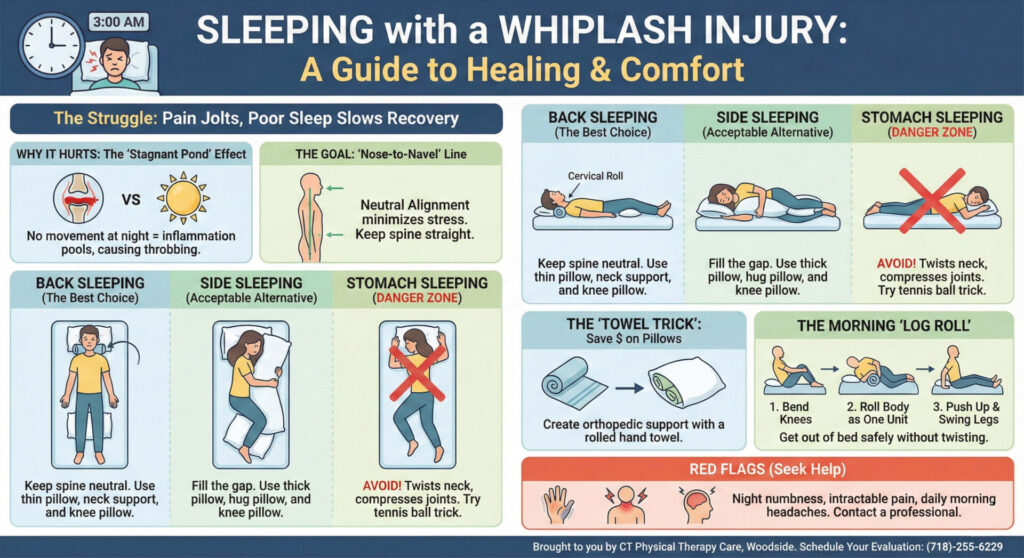
Position 1: Back Sleeping (The Best Choice)
For whiplash recovery, sleeping on your back acts as the gold standard. It keeps your spine neutral and evenly distributes the weight of your head.
How to optimize it:
- The Pillow: Use a thin pillow. A pillow that is too thick pushes your chin forward (flexion), straining the muscles at the back of your neck.
- The Support: You need support under the curve of your neck, not just the back of your head. (See the “Towel Trick” below)
- The Knee Relief: Place a second pillow under your knees. This position flattens your lower back and reduces tension that can travel up the spine.
Position 2: Side Sleeping (The Acceptable Alternative)
If you snore or have sleep apnea, back sleeping might not work for you. Side sleeping is safe if you fill the gap.
The “Gap” Problem: When you lie on your side, a gap exists between your ear and the mattress. If your pillow is too thin, your head drops down. If it is too thick, your head cranes up. Both positions pinch the nerves on one side of your neck.
How to optimize it:
- Fill the Gap: Your pillow must be thick enough to keep your nose parallel to the floor.
- The Body Pillow: Hug a pillow against your chest. This technique prevents your top shoulder from rolling forward and dragging your neck with it.
- Between the Knees: Place a pillow between your knees to align your hips and spine.
Position 3: Stomach Sleeping (The Danger Zone)
We will be blunt: You cannot sleep on your stomach with whiplash.
To breathe while on your stomach, you must turn your head 90 degrees to the side. Imagine walking around all day with your head turned fully to the right. That creates massive compression on the facet joints and twists the already-damaged ligaments.
If you are a stomach sleeper, you must retrain yourself during recovery. Try sewing a tennis ball into the front pocket of a t-shirt and wearing it to bed. If you roll onto your stomach, the pressure will wake you, reminding you to roll back.
The “Towel Trick”: Save $100 on a Pillow
Patients often ask, “Do I need to buy that $150 memory foam cervical pillow?”
Usually, the answer is NO. You can create the perfect orthopedic support using a standard hand towel.
How to make a Cervical Roll:
- Take a standard hand towel.
- Fold it in half lengthwise.
- Roll it up tightly into a cylinder (like a Tootsie Roll).
- Slide this roll inside your pillowcase, along the bottom edge of your pillow.
Why this works: When you lie on your back, the towel roll supports the natural curve of your neck (lordosis), while the pillow supports your head. This position gently opens the joint spaces and relieves pressure on the discs. You can adjust the towel’s thickness until it feels perfect.
The Morning Routine: The “Log Roll”
The most painful moment of the day is often the first time you try to get out of bed. Your muscles are cold and stiff. Jerking your head up to look at the alarm clock can trigger a painful spasm.
Use the Log Roll technique to protect your neck:
- Bend your knees while lying on your back.
- Roll your whole body (hips and shoulders together) to the side, like a log. Do not twist your spine.
- Push up with your arms while swinging your legs off the side of the bed.
- Sit up straight before standing.
Once you are up, use our Morning Stiffness Protocol to gently warm up your muscles.
When Sleep Problems Signal a “Red Flag”
While discomfort is typical, specific nighttime symptoms require immediate attention.
Contact CT Physical Therapy Care or your doctor if:
- Night Numbness: You wake up with hands that are completely numb or tingling. This symptom suggests your sleeping position is compressing a nerve.
- Intractable Pain: The pain is so severe that you cannot lie down at all.
- Morning Headaches: You wake up with a headache every single morning. This feeling often means your upper neck joints are locked.
Sleep is Part of Your Treatment
You can do your exercises perfectly and go to every doctor’s appointment, but if you spend 8 hours a night twisting your injured neck, you will not heal.
At CT Physical Therapy Care, we look at the big picture. When you come in for an evaluation, we talk about your sleep, work setup, and stress levels. We treat the person, not just the MRI.
If you are in Queens (Woodside, Maspeth, Astoria, Jackson Heights) and losing sleep over neck pain, let us help you find relief.
Schedule Your Evaluation Today or Call Us at (718)-255-6229